

In the spring of 2026, against a backdrop of regular blocks and slowdowns, foreign SIM cards (both physical and eSIM) grew noticeably more popular as a way around the restrictions. According to the Telegram-based outlet Baza, the number of requests for virtual SIM cards from foreign operators rose by hundreds of thousands. Mobile-Review, citing a representative of one of the operators, described the appearance of nine thousand roaming cards on his network in just two days. The logic was simple: a foreign operator’s card does not obey Russian block lists, because its traffic is handled abroad.
The geography and the market for this method are well described in an April analysis by the independent outlet Bumaga. Russians bought physical and electronic cards from Kazakhstan, Belarus, Armenia, Uzbekistan, and European Union countries.
Such SIM cards were easy to buy on the Russian marketplaces Ozon and Wildberries, on Avito (a Russian classifieds site), on AliExpress, and through Telegram bots. This parallel import of services is not limited to SIM cards. Marketplaces also sell access to, and top up wallets in, services that have left Russia, such as Spotify and Xbox Live. A French eSIM with unlimited data ran about €33 a month, while a Kazakh or Armenian one cost €22–30 for 20–30 GB. A whole market of travel eSIM services grew up (Yesim, Airalo, Unisim, and others), some of which accepted cards from the Russian payment system Mir and advertised working in Russia as a distinct feature.
By the end of June this method started to fail. Russian users of foreign cards began to complain that resources blocked in Russia no longer opened. Mintsifry (the Ministry of Digital Development) confirmed the change and explained the approach: “The roaming internet traffic of foreign subscribers operating on the networks of Russian communications operators is subject to the general filtering regime in effect on the territory of our country.”
The ministry stressed that this is not a full internet shutdown but a restriction of access to resources “blocked for violating the legislation of the Russian Federation,” and that the measure aims to “ensure security in the digital space.”
The picture is uneven, though. Eldar Murtazin, an analyst at Mobile Research Group, noted in a comment to Izvestia that the nature of the restrictions depended on the specific operator. With some cards it was possible to open the blocked Russian sites and the resources of the country of registration, but popular foreign social networks were blocked. Anastasia Bezrukova, a lead expert at the Center for Strategic Support of Domestic Technologies, provided an example in the same piece: with a card from the UAE, Gosuslugi (the Russian government services portal) and Arab resources open, but access to foreign social networks is closed.
This method was never a mass phenomenon. Denis Kuskov, CEO of TelecomDaily, noted in the same Izvestia piece that the scheme remained expensive (around €30 a month), and most users were not willing to pay that much. That is why we are talking about hundreds of thousands of subscribers, not millions.
The economic aspect is crucial. A sizable market has grown up around foreign SIM cards. One can find such cards at Russian marketplaces Ozon, Wildberries, and Avito for €6–60. Roaming traffic on certain plans costs €8–13 euros per GB. Travel-eSIM services that accepted Russian cards operated too.
The changes have hit three groups of people:
- roughly 500,000 users for whom this was the main access channel;
- resellers and services whose product suddenly lost its main advantage;
- foreign operators in countries bordering Russia, for whom Russian roamers were a steady source of income.
This loophole was closed not by banning sales, but by stripping the service of its utility. SIM cards are still sold legally; they simply no longer do (or will no longer do) the thing people bought them for.
The mechanics: why some SIM cards were filtered and others were not
To understand exactly what changed, you have to work out how internet traffic actually travels while roaming. There are two fundamentally different schemes here, and the whole story is about the shift from one to the other.
The first scheme is Local Breakout. A roaming subscriber connects to the network of the visited country, and their internet traffic goes out onto the global network right there, through the local operator’s equipment. This is the usual model: it ensures minimal latency and does not shuttle data halfway around the world. But since the internet exit happens inside Russia, the traffic passes through Russian filtering equipment and is subject to the same blocks as for an ordinary local subscriber. SIM cards operating under this scheme have always been filtered.
The second scheme is S8 Home Routing. As VoLTE technology (voice over LTE) spread, operators began switching to a different model. Here the smartphone in roaming reaches its operator’s home network through a secure tunnel, and that home network is what releases the traffic onto the internet. If a roamer in Russia has a SIM card from Kazakhstan, their smartphone connects to the Kazakh network. The traffic travels through a secure tunnel straight to the foreign operator, bypassing Russian filtering. In this case the Russian network acts only as a transit link: the data passes through it sealed and is “unsealed” abroad, out of the filters’ reach. These are the SIM cards that worked as a way around the blocks.
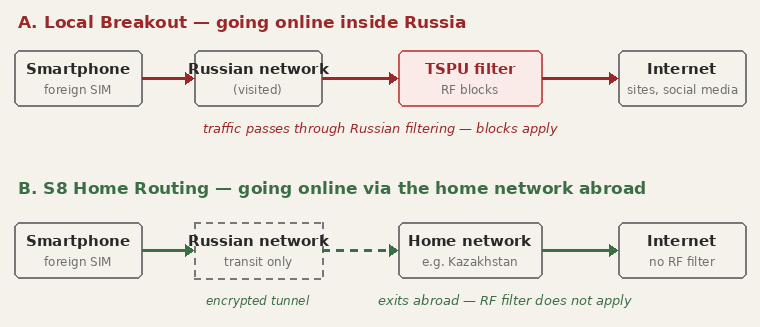
The second scheme is exactly what has now been shut down.
The difference between the schemes is clearly visible in user tests. In a dedicated thread on 4PDA web forum, participants checked specific operators using route tracing. With France’s Free and Kazakhstan’s Tele2, the connection from the device went to Google’s servers almost directly, bypassing Russian hosts, which is classic home routing. With Kazakhstan’s Beeline, however, the traffic went through Russian nodes, and the author of the test highlighted the instability. Six months earlier resources blocked in Russia would not open through this operator, then they worked again, meaning access can vanish at any moment. This is a living example of how the fate of a specific SIM card depends on the roaming architecture of its operator, not on the country named on the packaging.
Why is it technically hard? Why filtering “depends on the operator”? In home routing, the traffic travels through an encrypted tunnel, and you cannot look inside it to block a specific site directly. Anna Kashnitskaya, founder of the Unisimka service, explains the consequence in Hi-Tech Mail: the operator of the receiving network cannot selectively interfere with secure roaming traffic and filter individual services inside it, so data transmission is either allowed in full or cut off in full. That explains both the instability and the different behavior across cards. In some cases the operator has made an arrangement and the traffic travels through the local breakout (and meets the filter). In other cases the tunnel is simply switched off from time to time. Filtering roaming traffic is difficult but technically possible, according to one of the cellular network planning specialists who talked to Izvestia. The measures used include temporarily switching off the channel, checking activity, and arrangements with foreign operators.
User complaints and operators’ response
The problem is real and does not come down to a ministry statement, and independent evidence (including from abroad) shows it.
On the travelers’ forum Tripadvisor, foreigners had been describing mobile internet outages upon entering Russia since as far back as the fall of 2025. A user with Norwegian Telenor cards lacked internet connectivity in Pskov, Vladimir, Tver, and St. Petersburg, while some Russian services (Yandex Go, Navigator, Ostrovok, RZD) remained available. The same person described selective filtering in Pskov and Vladimir where only a subset of sites and services was blocked. He summed it up with a bluntness you would not expect from a tourist: “Actually, I was surprised they hadn’t blocked roaming internet earlier.” English-language travel guides record the same trend. According to nadanada, users who purchased foreign eSIMs specifically to get around the blocks reported growing outages throughout the first half of 2026.
The response of foreign operators is telling too. Mobile companies in Belarus (A1, MTS) and Kazakhstan (Kcell, Beeline) warned subscribers about roaming restrictions in Russia. Users on Russiable described a bilingual SMS from Beeline that arrives on connection. The message said that roaming internet and SMS were restricted and offered a link to complete identity verification to lift the restriction. In particular, users were asked to turn off their VPNs first.
There’s a related measure not to confuse with the main one. When a foreign SIM card first connects to a Russian network, mobile internet and SMS are blocked for 24 hours. This was introduced in October 6, 2025 and is called “cooling-off period”. The authorities justified this practice by citing the fight against drones controlled through foreign networks.
Open data analysis
Let’s compare the Mintsifry statement and the user complaints using independent measurements. OONI (Open Observatory of Network Interference) is an open system for monitoring internet censorship. Volunteers around the world run the OONI Probe app. It tests whether sites are reachable or not. The results go into a public database. We queried it directly through the OONI API.
First, a methodological detail. Any OONI measurement is tied to the network from which the traffic exited to the internet. For a foreign SIM with home routing, the exit point is abroad. So, a probe run physically in Russia lands in the statistics of the country where the traffic was “unsealed” (Kazakhstan, France, and so on), not Russia. That means the trace of roaming-traffic filtering must be sought not in Russian statistics but in anomalies for RF-blocked resources within measurements attributed to the networks of neighboring countries.
We pulled the anomaly rate for the daily availability test of Instagram (blocked in Russia) in four countries from June 1, 2026 to July 10, 2026. In OONI’s terms, an anomaly is a measurement where the connection ended abnormally: a TCP reset, a broken TLS handshake, or an unexpected server response. It is not necessarily deliberate blocking, but it is a sign of interference with the traffic.
France is the control point. There was a hypothesis that the share of French operators in Russia (Free in particular) was large. But with 330 to 535 independent measurements per day, the anomaly rate never once exceeded half a percent over all forty days (a maximum of 0.48% on June 22, averaging around 0.13%). This is what the normal baseline of a healthy network without filtering looks like: a flat line near zero. Latvia stayed right there the whole time.
Kazakhstan is the main result. Throughout June the figure stayed within the background noise (0.5 to 2%), but on July 8 there was a sharp and sustained jump: around 10 to 11% anomalies three days in a row, with a sample of more than a hundred independent measurements per day. The date coincides with the start of filtering that Kommersant reported, and the shape of the spike (a sudden onset, a large volume of data, several days in a row) is hard to write off as chance. This is exactly the fingerprint we were looking for: traffic exiting through the Kazakh network began hitting an obstacle right when Russia extended filtering to roaming.
We present Estonia honestly, as an ambiguous signal. There, a noticeable cluster of anomalies (up to 15 to 31%) fell on June 8 to 15, long before the July news. But the Estonian sample is small (15 to 38 measurements per day), and there is no basis for linking this episode specifically to roaming filtering. Perhaps you can help us explain the Estonian anomaly. Write to us at [email protected].
An important caveat: OONI data depend on how many volunteers ran probes and on which networks. Samples for small countries are small too, and a measurement only records symptoms. This is strong circumstantial evidence, matching the announced measure in timing and character, not final proof. Anyone can re-check the raw data at explorer.ooni.org.
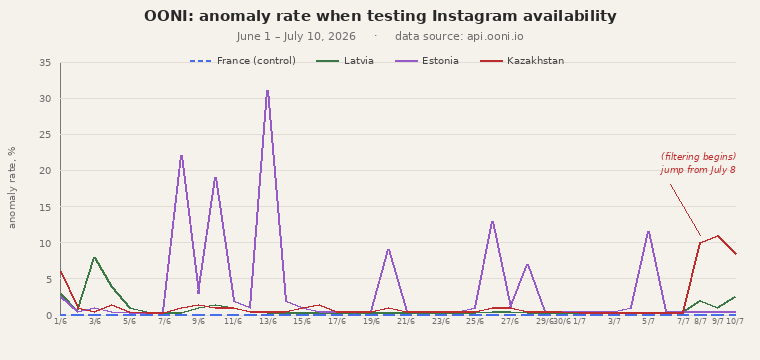
The anomaly rate in the daily Instagram availability test via OONI, June 1, 2026 to July 10, 2026. France and Latvia make the baseline level. In Kazakhstan a sharp jump appears from July 8, coinciding with the start of filtering of roaming traffic. Data source: api.ooni.io.
The legal side: they are filtering a foreign operator’s service
The most contentious part lies in the legal domain. Technically and legally, the new measure means that the Russian state is extending its filtering system to a service provided by a foreign communications operator, including to a foreign citizen who is in Russia with a card from their own country.
How unusual this is becomes clear when you recall how cross-border roaming agreements work in the first place. Sarkis Darbinyan, co-founder of Roskomsvoboda (a cyber-rights NGO) and a cyber-lawyer, describes the basic principle in a piece by Novaya Gazeta Europe. There is an agreement between operators of different countries about how they handle user traffic, explains Mr. Darbinyan. When you travel to Europe with a Russian SIM card, Roskomnadzor (the Russian communications and media regulator) “travels” with you. The same logic should work in reverse: with a foreign SIM card in Russia, the traffic goes through the foreign operator and by its rules, and Russian filtering should not apply to it.
The new approach breaks this logic. The reference point becomes not the operator’s country but the subscriber’s physical location. If a person is in Russia, their traffic is filtered the Russian way, whoever’s card is in the phone. This can be read as extraterritorial application of national censorship. The restrictions catch a service provided by a foreign legal entity under a contract concluded in another country. Observers point out that international roaming is a standard and legal telecommunications service, resting on the conventions of the International Telecommunication Union (ITU) and bilateral roaming agreements within the GSMA. Russian bans formally target VPNs and “anonymizers,” not roaming infrastructure, so interfering with it means moving along the edge of international telecom norms.
There are problems with legal certainty here too. As Darbinyan explains to Novaya Gazeta Europe, the authorities do not directly ban foreign SIM cards. They can complicate their operation at any time by “leaning on the mobile operators” so that these operators demand their foreign partners revise the roaming agreements. The harshest scenario is an order from Mintsifry and the FSB (the Federal Security Service) obliging operators to restrict or shut off the network or data transmission. In international practice this takes the form of service restriction orders, which are also provided for by GSMA rules. “This is the harshest scenario, because if such an order exists, a foreign eSIM also stops working, since the problem is no longer in the eSIM but in the legal prohibition on service or on data transmission,” Darbinyan says. In other words, the measure is carried out technically, invoking the general filtering regime under the “sovereign internet” law, while no separate and transparent regulation of foreigners’ roaming traffic specifically has been published.
The legal basis for the filtering itself comes from the Russian “sovereign internet” law (Federal Law No. 90-FZ) and the TSPU (technical countermeasures against threats, deep packet inspection equipment) that operators are required to install, which Roskomnadzor manages centrally through its Center for Monitoring and Control of the Public Communications Network. We have already analyzed exactly how this infrastructure makes it possible to filter and restrict traffic at the operator’s network level without entering resources into a public registry and without a separate court decision in each case. Roskomsvoboda has long pointed out that this model undermines legal certainty: a user cannot know in advance what will be restricted for them, or on what grounds.
What this means for developers
Roaming filtering hits not only users of foreign SIM cards but also those who build tools for access to a free internet.
Following the anti-VPN campaign, yet another method of censorship circumvention is being shut down. A foreign SIM with home routing let you reach blocked resources without a VPN. Now this backup path is narrowing, and the load returns to VPN tools, which are already under growing pressure. We have analyzed this question.
The main lesson of roaming filtering is for the design of circumvention. The government demonstrated its ability to reach even traffic that physically leaves for a foreign network. The reference point became not where the SIM is registered but the fact that the subscriber is physically in Russia. The practical takeaway for a developer: resilience comes not from the “foreignness” of the exit point in itself, but from making the traffic indistinguishable from legitimate traffic. Disguise as ordinary HTTPS, operation over standard ports (not VPN ports), and dropping recognizable signatures used to be options; they are becoming mandatory by default.
Preliminary conclusions
- A foreign SIM is no longer a universal solution. As a way around the blocks, it has become unreliable: its behavior depends on the operator and the roaming model, and the traffic is filtered more and more often. You should not count on it as a stable channel.
- Something already connected works better than something new. It is worth noting that a SIM activated before entering Russia more often keeps working, while attempting to activate a new profile once inside the country may fail. This comes down not so much to roaming as to access to the technical infrastructure.
- Services that left on their own are still available for now. Resources that restricted their operation in Russia by their own decision (rather than being blocked by Roskomnadzor) most often open with a foreign SIM card. These are different categories: a block by the government and a service leaving.
- Remember the costs and risks. Roaming traffic is more expensive, and in case of failures or erroneous charges you are unlikely to resolve the issue quickly with a foreign operator. And the “cooling-off period” can leave a new card without internet and SMS for a day upon entry.
- VPNs remain a separate topic. A foreign SIM and a VPN are different tools; here we are analyzing roaming specifically. Those who care about access to information should look at the methods as a set, rather than relying on just one.