

How a screenshot gets you removed from the ballot
On June 4, 2021, Vladimir Putin signed a law that bars anyone involved with “extremist organizations” from running for office for up to three years. Its main target was Navalny’s organizations, which the authorities had designated “extremist.”
Because of this law, 38 people could not run as candidates in 2021, and at least 23 more candidates dropped out over administrative charges of displaying “extremist symbols.” For example, Perm activist Sergei Ukhov was accused of links to Navalny’s organizations because of a screenshot in his own channel.
By 2026, the scheme had been polished. According to a count by Verstka (an independent Russian media outlet), almost 40 opposition candidates were removed from the ballot. The main tool has been Article 20.3 of the Code of Administrative Offenses. Anyone convicted under it loses the right to run for office for one year. Authorities found banned content on the social media accounts of 27 politicians. In seventeen cases, the grounds were posts that mentioned Navalny or contained a photo of him.
In seven cases the grounds were links to Facebook and Instagram. Russia has designated Meta an extremist organization, so a link to one of its services can count as displaying the symbols of a banned organization. A person posts a page address and, a year later, finds out they cannot run in an election.
For example, on September 7, 2026, police in Yekaterinburg detained six candidates from Yabloko (a liberal opposition party), including Vladimir Sobyanin. They faced the same charge of displaying extremist symbols. On September 5 in Novosibirsk, police detained an activist after a picket with a sign reading “I don’t vote for United Russia.” OVD-Info keeps a detailed chronicle of the authorities’ campaign against independent candidates (the state has branded this project which writes about political prisoners and has helped them “extremist” as well).
People also face prosecution for writing on ballots. In March 2024, a woman wrote “No to war” on her ballot. A police officer on duty at the polling station saw the writing and detained her. Authorities then opened a criminal case against her under Article 141 of the Criminal Code (obstructing the exercise of electoral rights). Lawyers pointed out that to do this, the officer had to violate the secrecy of the ballot himself. In Krasnoyarsk Region, authorities jailed a woman for two months for putting brilliant green (a green antiseptic dye) on her own ballot. And an official in Bashkiria publicly explained that damaging a ballot could bring 10–12 years in prison, adding: “Insulting and undermining the foundations of power is extremism.”
Observation is shrinking
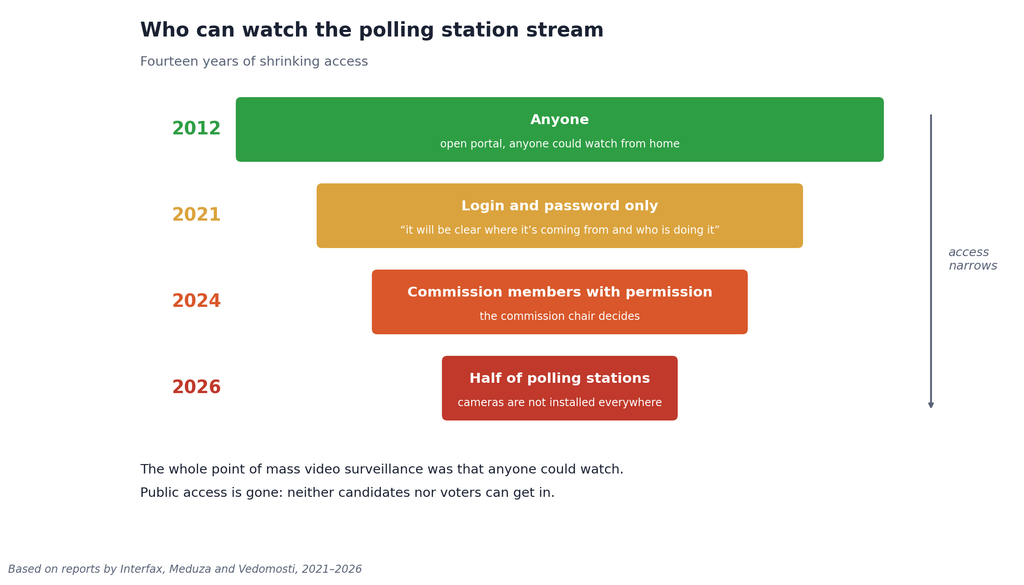
Mass video surveillance appeared in 2012 as the authorities’ response to the protests after the State Duma election. Cameras went up at polling stations, a portal opened, and anyone could watch the stream from home. People looked for acquaintances in the frame. However, only authorized bodies could get the recordings after the fact. That is why observers made their own recordings.
In 2021, however, the Central Election Commission (CEC) ended open streaming. CEC chairwoman Ella Pamfilova explained that the public portal had always attracted malicious actors, and that from then on access would require a specific person’s login and password. She said: “We are not restricting them. It’s just that it will be clear where it’s coming from and who is doing it.” A year later, responding to a proposal to bring back open streaming, the CEC head warned: “Let’s see how they whack you there. If they whack you, they whack you, since that’s what you decided.” And whack they did.
In 2024, the authorities restricted access even for members of election commissions. Watching the stream now requires permission from the commission chair. By 2026, video surveillance covers only half of polling stations.
Voting without observation
This year, remote electronic voting is available in 33 regions, covering 48.4 million voters.
The 2021 elections in Moscow showed what happens to observation under this kind of voting. At regular polling stations where observers worked, “Smart Voting” (Navalny’s tactical voting project) candidates were winning in eight of fifteen districts. Once the electronic votes were added, they lost in all fifteen.
There is no way to verify the counting system. It is closed both to observers and to the election commission. The system records votes on two blockchains, and the second one is not public. The database mixes valid ballots with ballots canceled because of re-voting. And there is no public way to tell them apart.
Officials announced the results of Moscow’s electronic voting late, and only as a combined total with the paper ballots to avoid stirring things up.
An observer has nothing to observe here, even with full access. There is no room, no ballot box, and no ballot. There are only numbers you have to take on faith, and this is very convenient.
The network goes down
The final boss (and the main trend of this election). Russia’s first large-scale shutdown happened in Moscow in August 2019, during protests over candidates being barred from the Moscow City Duma election. At the time, mobile internet disruptions were local, and people saw them as an emergency.
By 2025, network shutdowns (including during elections) had become routine. Summing up the Single Voting Day (Russia’s unified annual election day), a representative of the Ministry of Digital Development said that the mechanism of lists of government-approved websites (also known as “whitelists”) had been used successfully. According to the official, even when the internet was shut down, resources related to electronic voting remained available. There were outages, but they were short: up to fifteen minutes for MegaFon in Perm Region and Karelia, and in some districts for T2 (formerly Tele2), which restored service within half an hour.
In June 2026, Ella Pamfilova warned that restrictions were also possible during the State Duma election and asked people to be understanding. “No need to grumble,” she said, since this was about saving lives. She did not specify whose lives or under what circumstances.
Officials promise to set up additional wireless access points at polling stations. They have not explained how these will connect to backbone networks if external internet access is shut down.
According to data by Access Now, Russia ranked fourth in the world by number of shutdowns in 2025, with 19 cases, after Myanmar, India, and Pakistan. Russia accounts for most of the shutdowns in Europe.
Electronic voting services are on the same register of socially significant resources (the “whitelist”) that we covered in details. When mobile internet is shut down, you will be able to vote, but you will not be able to check what is happening at the neighboring polling station. In short, access to the procedure is guaranteed, while access to information about it is not guaranteed at all.
How the authorities used Big Tech to fight Smart Voting
On August 19, 2021, a month before the State Duma election, Roskomnadzor (RKN, Russia’s internet and media regulator) demanded that Apple and Google remove the app. On September 16, the agency threatened the companies with fines. At the same time, attackers targeted the project’s website and Telegram bot. On September 17, both companies removed the app from their Russian app stores; outside Russia, it kept working. Google did this under the threat of criminal prosecution of its employees. Apple’s letter to the app owner cited the app’s link to FBK (Navalny’s Anti-Corruption Foundation) as the reason and added that complying with local laws is the developer’s responsibility.
On the night of September 18, 2021, Pavel Durov blocked the bot on Telegram, citing the “days of silence” (the legally mandated pre-election campaign blackout). However, three-day voting has no days of silence. As Durov explained, Apple and Google, as the makers of the two main mobile operating systems, “are at the top of the food chain of information distribution and can dictate the rules of the game to developers like us.”
On September 18, Google demanded that the team remove the candidate lists from its own document service (Google Docs). Roskomnadzor publicly accused Google, Apple, Cloudflare, and Cisco of helping the project circumvent blocking. At the same time, the authorities pressured voters with prank calls, publications about data leaks, and police visits offering to help them file a complaint about the theft of their personal data.
Five years later the authorities apply the same mechanism of pressure on app stores to VPN services (and again, not without Big Tech’s help). Big Tech itself faces blocking too, but that does not stop it from cooperating with censorship authorities.
The Belarusian case
In August 2020, on the eve of the presidential election in Belarus, the Golos (“Voice”) platform asked voters to photograph their filled-in ballot and name their polling station. Users logged in with a phone number. Importantly, in Belarus you cannot buy a SIM card without a passport. This restriction helped confirm that the participants were real voters and not bots from abroad. Meanwhile, the Zubr project recorded violations, and the Honest People initiative collected commission protocols (official vote tally sheets).
The result: data from more than a million voters, 900,000 of them tied to a specific polling station, plus 1,545 digitized precinct commission protocols. Combining these datasets made it possible to reconstruct the real picture and show falsification at a third of polling stations.
The authorities were not idle either. On the eve of the election, the Prosecutor General’s Office of Belarus proposed that the communications minister restrict the website. On election day, someone tried to spoof the platform, so the project accepted photos through chatbots that people had started using in advance.
Why blockchain doesn’t help in our case
People regularly propose running independent elections on a blockchain. Russia’s remote voting already runs on a blockchain, and that has not made it verifiable.
A blockchain guarantees that no one altered the records after the fact. But it does not solve the other problems of remote voting.
- You cannot inspect the software that encrypts your vote, so you have to take it at its word.
- Someone can force you to vote under supervision, and no cryptography will detect it.
- Someone still decides which records count as valid. In the Moscow election five years ago, one of the blockchains turned out to be non-public.
An independent oversight tool must be verifiable by an ordinary person, not only by a specialist. In this sense, a photo of a ballot is more reliable than any distributed ledger.
International context
Election-related shutdowns are not a Russian invention. Access Now research shows that they peaked in 2018 and 2019, with 12 election-related shutdowns each year. After a decline in 2020–2023, they are rising again: the authorities of Azerbaijan, the Comoros, India, Mauritania, Mozambique, Pakistan, and Venezuela have shut down the internet during elections. Here are a few examples from recent years.
- In 2020, Belarus blocked social networks, VPNs, and Tor, and lifted the restrictions only after the election commission declared Lukashenko the winner. The Belarusian authorities did the same during the 2025 election.
- In October 2025, Tanzania imposed a five-day nationwide shutdown that coincided with a power outage and a curfew.
- Before the 2024 election, India banned the use of VPNs in Jammu and Kashmir for a month.
How the vote went
The vote is over, so we can compare the forecasts with the facts. Instead of retelling official statements over and over, we took independent measurement data and analyzed it.
There was no mass shutdown
People spent the whole summer preparing for one after Ella Pamfilova’s June speech. On the eve of the vote, she softened her wording: “There may be some, let’s say, unintentional disruptions of mobile communications and data transmission. For us, this is not a reason to cancel the vote.” She also explained that the CEC does not shut down the internet, because such decisions are outside its authority.
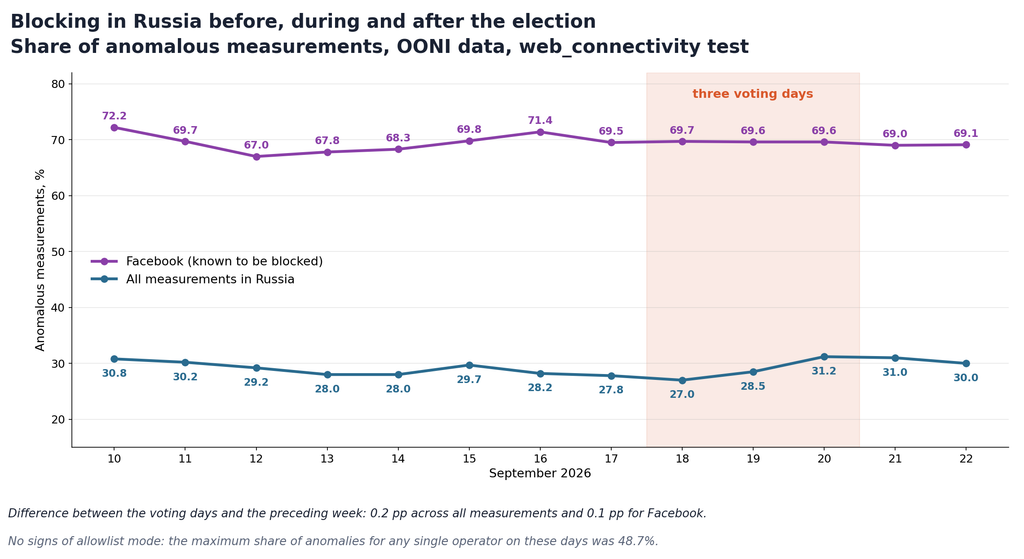
The measurements confirm this. According to OONI data, the share of failed connections in Russia stayed around 29% throughout the first half of September and remained at the same level on the voting days. On September 18, the first day, the figure was even the lowest in two weeks: 27.0%.
As a control, we looked at a resource known to be blocked. For Facebook, the share of failed measurements was 69.5% in the baseline week and 69.6% on the voting days. The difference is one tenth of a percentage point.
On the main day restrictions were tightened selectively
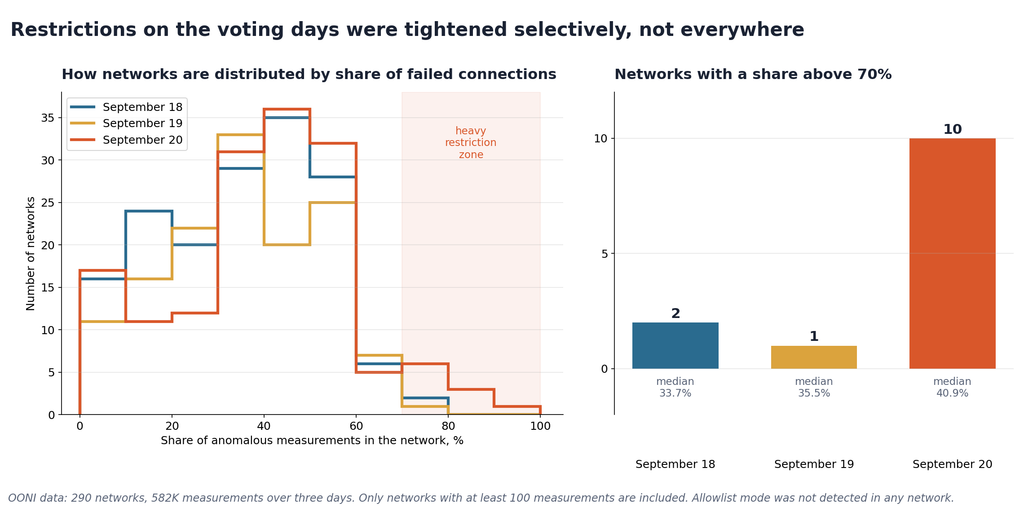
The national figure hides what becomes visible in the per-network breakdown. We analyzed 582,000 measurements across 290 autonomous systems (AS) over three days. The median across operators rose from 33.7% on September 18 to 40.9% on September 20. The number of networks where more than seventy percent of connections failed changed as follows: two on September 18, one on September 19, and ten on September 20. There were no networks with a share above eighty percent on the first two days; on the main day, there were four.
Among the major operators, MegaFon changed the most: 25.8% on the first day, 32.6% on the second, and 48.2% on the third. Rostelecom saw a more modest increase, from 33.1% to 37.8%; MTS went from 29.4% to 37.1%, and Beeline from 25.3% to 37.2%. MGTS stayed around 49% on all three days, and ER-Telecom around 33%.
Allowlist mode was not switched on
In this mode, everything that is not on the register goes down, so the share of failed connections in an affected network jumps to 90–100% across all addresses at once.
Over the three days, we found this pattern in only one network out of 290. Moreover, on September 18 it showed the same 91.7%, so we can assume that this network stays in this state permanently, regardless of the election.
This means the authorities did not need the technology they had tested during the 2025 election this time. There was simply no point in it.
The outage in the Far East is confirmed
On September 19, Rostelecom reported that two backbone lines had been put out of action. In one case, someone sawed down a pole, and in the other someone cut a cable. Company president Mikhail Oseevsky called it organized sabotage. The company restored service in about an hour.
We cannot verify the cause, and there have been no reports of arrests or criminal cases. The outage itself, however, is confirmed: the IODA outage monitoring platform recorded a critical drop in connectivity in Khabarovsk that day, with an anomaly level of 34.3% and timestamps of 06:50 and 07:10 UTC.
The official attack figures are less clear-cut
The CEC and Roskomnadzor reported that they had repelled more than one hundred million potentially dangerous cyberattacks. They also reported 918 emergencies on election commission communication networks, as well as phishing sites posing as official ones.
These figures do not match each other. After the same briefing by Pamfilova on September 20, Vedomosti reported more than a thousand DDoS attacks, 124 of which targeted the electronic voting system. Kommersant reported more than three thousand waves and 135 attacks. Roskomnadzor gave its own figure of fifteen hundred. That is a threefold discrepancy within a single day. There is no independent confirmation: the statements come from the same agencies whose work these attacks allegedly disrupted.
A blind spot: no one monitors the voting services
We checked what OONI measurements show for Gosuslugi (Russia’s state services portal), which handled authentication for electronic voting in 33 regions. Over two weeks, the database contained a single measurement for this domain. For comparison, it contained almost twenty-five thousand for Facebook over the same period.
The reason lies in how the test lists work. The community compiles them, and they include what people consider likely blocking targets: independent media, messengers, and circumvention tools. Government portals do not fit this logic. As a result, no one is interested in testing the infrastructure that the elections rely on.
We partly filled this gap ourselves. Earlier we checked availability from seven vantage points. We found that Gosuslugi and the identification system (ESIA, the government single sign-on) did not open from a virtual server in Germany, although vybory.gov.ru and mos.ru opened from the same point in the same run. So traffic to Russian government resources does get through from there, and it is Gosuslugi specifically that refuses the connection.
By the voting days, the picture had become more complete. The mobile app for electronic voting worked over home networks in Europe and St. Petersburg, but it refused access through every virtual server and VPN we tested, including Russian ones. Election commission portals, including the CEC website and regional commission sites, failed to open on every attempt from foreign vantage points.
We should add that, according to Foreign Minister Sergei Lavrov, the number of polling stations in Western countries fell by sixty. On the other hand, some Russian consulates closed for reasons other than Russia’s own decision. As a result, the reduced capacity helped shrink the traditionally protest-leaning vote outside Russia. But that is a different story.
What this means
Election day required no special blocking or censorship effort: the measures that already operate every day were enough. There was a targeted tightening on September 20, and it is measurable. But it affected 10 networks out of 290.
And that brings us back to where this analysis started. There is no public way to check how the voting services themselves performed: there are almost no independent measurements for them, and the authorities do not publish official availability reports.
How we calculated
We took the data from the OONI open API (web_connectivity test, country RU). The daily figures cover September 10–23, and the breakdown by autonomous system covers September 18–20: 5,058 rows, 290 networks, and 582,000 measurements. The distribution calculation included networks with a sample of at least one hundred measurements per day. We checked the per-network totals against the daily totals, and they matched exactly.
Queries you can use to reproduce this:
Recommendations for developers based on these days
We have collected lessons from what broke during the election.
External dependencies fail first. People complained that search engines and banks would not open, even though the network was technically up. If fonts, scripts, CAPTCHA, or maps load from third-party servers, the page will not fully render. So keep critical components on your own infrastructure and make everything else optional. For example, a CAPTCHA hosted on an external service blocks logins and forms. A user cannot sign up or contact you if the CAPTCHA does not load. You need a fallback.
Throttling is more dangerous than a shutdown. That is exactly what these days looked like: the connection is there, but heavy content does not load. Key pages must open on a poor connection, so check their size. The long-forgotten tradition of counting bytes is becoming relevant again.
Push notifications will not arrive, because they go through Google and Apple servers. Set up a backup channel for urgent alerts.
The gap between operators can be as large as twofold. On September 20, 48.2% of connections failed on MegaFon, compared with 33% on ER-Telecom. The same service worked differently for different people that day, and “it won’t load for me” complaints could come from subscribers of a single network. If you track availability statistics, break them down by operator. Otherwise, the averages will hide your users’ problems.
Freeze releases on days like these. Factor anniversaries and political events into your release schedule. Fixing anything over a bad connection is hard.
Build monitoring from multiple vantage points. And if you can, share this data. This election showed why it matters: official outage figures differed threefold, and there are almost no independent measurements of government services. Availability logs tied to time and network are your contribution to the overall picture of how the Runet (the Russian segment of the internet) is functioning. For a quick check of the access regime, you can use our tool. Feel free to use it.