
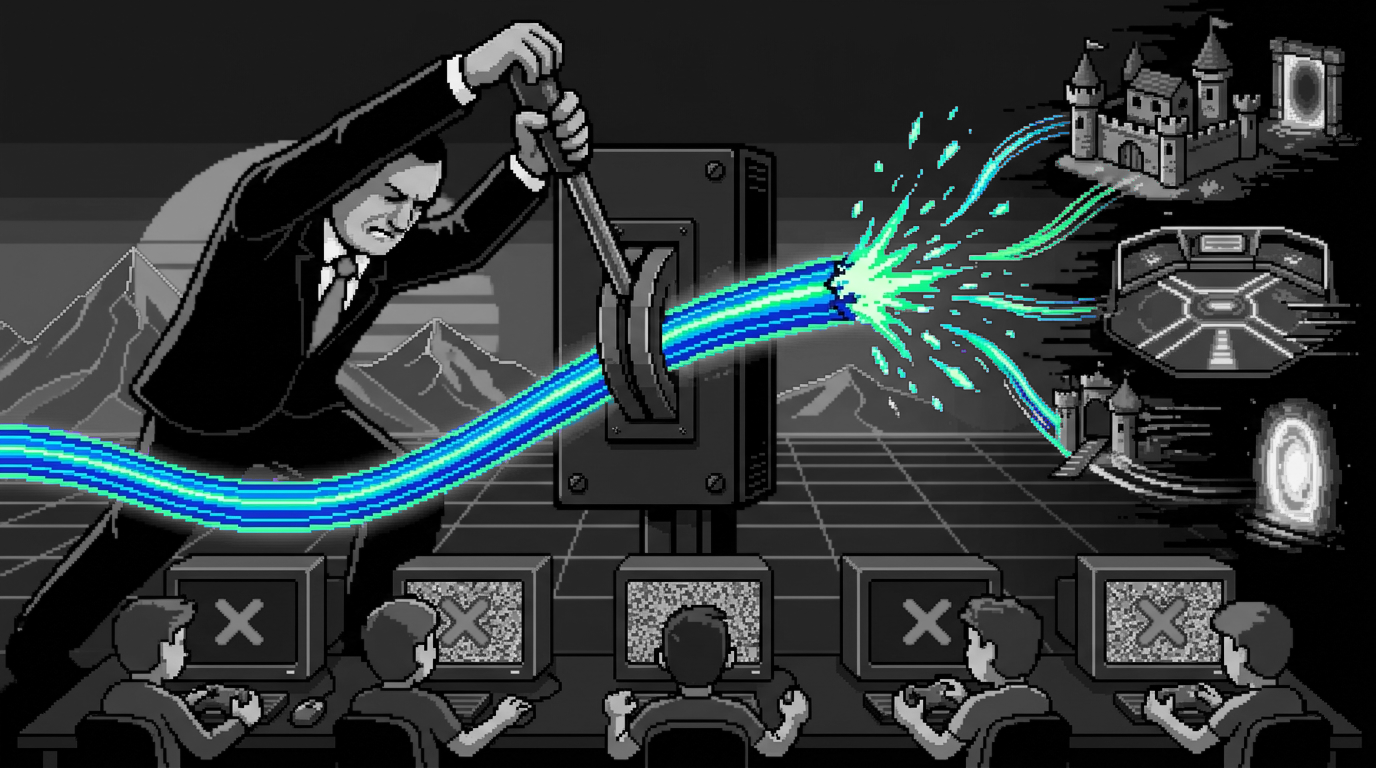
In mid-July 2026, players in Russia ran into a mass problem: popular online games stopped connecting to their servers without a VPN. Kod Durova (“Durov’s Code,” a Russian tech news outlet) was the first to notice the complaints. After that the story spread to the media and social networks.
The key points:
- The games affected first are from Blizzard and NetEase (the developer companies): Diablo IV, World of Warcraft, Overwatch, as well as Marvel Rivals and Neverness to Everness. For Blizzard, all of this is tied to the Battle.net platform.
- It’s a network symptom. The launcher and the website opened, the game started, but the connection to the game server times out (in Diablo IV this is error code 300008). With a VPN, or after changing the network route, everything works fine.
- This appears to be a block originating from Russia rather than a publisher withdrawal. There are no direct official statements from Roskomnadzor (the Russian communications and media regulator), but the combination of signs points to network interference inside the country.
- The mass wave began on July 15, 2026 with initial reports emerging on July 9. Judging by players’ accounts, the restrictions first showed up in specific regions and then spread across the country.
In this article we will talk about how to tell a block apart from publisher sanctions (these are different things), why it is specifically the game connection that drops, why the authorities might want this, and what you can do.
What’s happening
On July 15, 2026, a wave of complaints rolled through Russian gaming communities. Diablo IV, World of Warcraft, Overwatch, Marvel Rivals, Neverness to Everness, and a number of other online projects failed to connect to the Internet without VPN. Some users managed to launch their games but they did not work as usual. Users cannot start missions, watch an endless loading screen, or drop out on a timeout.
On the Blizzard forum and on DTF (a Russian gaming and pop-culture platform) users described that the Battle.net launcher opened normally, the game started, but then the connection to the game server dropped. In Diablo IV there is error code 300008 with the message “Your login attempt has timed out,” which appears before the character selection screen. Access can be restored with a VPN or the Cloudflare WARP service.
Let us clear up one point of confusion about the error code separately. Some retellings mention “30008” (five digits), but that is a typo: the real Blizzard code is 300008 (six digits). It is a standard login-timeout message that players see all over the world, and usually it means the service is overloaded. What makes the Russian case unique is that it appears en masse and clears up when you change the route.
According to accounts on DTF, the first problems appeared around July 9 and affected individual regions, and on July 15 the restrictions spread across the whole country.
What our data collection showed
To make sure this was not a local problem affecting a few individual players, we went through open sources and gathered data for the period from mid-June to July 16, 2026. We used data from outage aggregators, official developer forums, gaming communities, and specialized media. The sample included around fifteen independent sources.
The picture that emerges is consistent. On the official Blizzard forum, the thread about error 300008 in Diablo IV gathered several dozen replies and thousands of views in a week; there is also a separate Russian-language thread with the same code. For Marvel Rivals, fresh Russian-language discussions of the Server Connection Failed error appeared on Steam, and the Russian outage aggregator Detector404 recorded a spike in complaints about gaming services and keeps Battle.net and Marvel Rivals under monitoring. Specialized outlets confirmed the problem too, from iXBT.games to cybersport.metaratings.
The number of “signals” in such sources is not an exact count of those affected but a set of observable metrics (replies in threads, views, spike markers on an aggregator). Their consistency matters more than the absolute figures: the complaints come from different regions, across different games of the same class, and within one and the same short period. That sets the situation apart from a one-off failure at a specific provider or for a single player.
Timeline
- July 9: the first signals that Diablo IV could not connect on PC, PlayStation, and Xbox. The problem can be described as local.
- July 13-14: the number of complaints grows. Threads about error 300008 appear on the Blizzard forum (including Russian-language ones). Discussions of the Server Connection Failed error in Marvel Rivals appear on Steam.
- July 15: a mass wave across the whole country. The first media publications.
- July 16: the problem persists. Some players continue to report that the games are unreachable without circumvention tools.
The mechanics
An important caveat: we did not run the games in a lab and cannot show the process “from the inside.” If you can share your personal experience, write to us please. This description rests on players’ accounts, error codes, and open technical breakdowns. It explains why the picture looks exactly like a network block.
An online game does not talk to a single server but to several groups of nodes: the website and account login system, the authentication servers, the game servers (matchmaking and the game session), and the update servers and CDN. These groups sit on different domains and IP addresses. When a player complains that “the launcher works but it won’t let me into the game,” it means one group of nodes is reachable and another is not.
This is exactly what error 300008 in Diablo IV looks like. According to community breakdowns, Battle.net opens, checks for updates, and starts the game, but the connection to the game server times out before character selection. Changing the account region and reinstalling do not help, while a VPN does. That separates the problem from two other possible causes. If the issue were with the account (a ban or sanctions), a VPN would not save it; if it were a general Blizzard outage, it would affect players worldwide rather than only in Russia.
That leaves network interference on the route between the Russian player and the specific game servers. Technically, this is done through filtering by the game servers’ IP addresses, or by domain/SNI at the stage of establishing a secure connection, with the same class of tools (TSPU, technical countermeasures against threats, the deep packet inspection equipment) that we examined in our materials on blocking. Indirect confirmation of the network nature is the fact that in some cases Cloudflare WARP helps: it changes the route and “hides” the traffic’s destination, getting around the filter.
Hence the different behavior across different games and services: it all depends on which specific IPs and domains fell under the filter and on how a particular publisher’s network infrastructure is built.
Why the authorities would want this
There is no official explanation. Neither Roskomnadzor nor the relevant agencies have commented on the block. We can only judge the goals from experts’ assessments and from how this story fits into the broader picture. There are two main versions here, and they do not rule each other out.
Version one: collateral damage. Many specialists lean toward the idea that the games fell under the filter not deliberately but as a side effect of the fight against other services. As industry commentators explain, while trying to block a specific proxy or VPN node that keeps an “undesirable” messenger running, the regulator may shut off a whole range of IP addresses, and the login servers of online games happen to end up inside that range. Game traffic also often shares infrastructure with large cloud providers like Cloudflare, and that makes it especially vulnerable to “carpet” restrictions. This version is also supported by the fact that similar waves of outages happened before: in early 2026, players complained about R.E.P.O., Call of Duty: Mobile, and VRChat.
Version two: part of a systemic policy. Even if this particular block is a side effect, its very scale and regularity indicate that whole subnets, routes, and cloud platforms are increasingly falling under filtering, rather than individual sites from a list. In this logic, the games suffer not because they specifically bother anyone, but because the state is building an infrastructure of total network control in which any foreign service is a potential victim. This is the same line as in our analyses of messengers, eSIM, and traffic filtering: the space of free access to foreign services is steadily shrinking, and entertainment services are no exception.
Neither version assumes that someone deliberately decided to “cut gamers off from Diablo.” Rather the opposite: it is telling that even a politically neutral form of entertainment ends up under the wheels, which is an indicator of just how widely the net of restrictions has been cast.
A block vs a publisher leaving
This is the key question of the analysis. Different mechanisms coexist around games in Russia, and people constantly mix them up.
A network block (our case, July 2026). Access to the game servers is restricted at the network level inside the country. The game and the account are fine, but the traffic does not get through. Symptoms: VPN can help, the problem affects only users in Russia, and there is a connection timeout.
Sanctions and the publisher pulling out. Back in 2022, Blizzard restricted purchases, subscriptions, and wallet top-ups for Russia and Belarus, and began unlinking Russian phone numbers. But that concerns the store and payments, not network access. Playing with a Russian IP address was technically possible. Marvel Rivals has been unavailable for official download in Russia since November 2024, which is also a decision on the side of the publisher and the stores, not any network block. These restrictions exist in parallel and do not explain the July network outage.
Nationalization and “extremism” cases. An interesting story happened to “World of Tanks”. After Wargaming left Russia and Belarus in 2022, the games split up. World of Tanks, World of Warships, World of Tanks Blitz stayed international. The Russian Mir Tankov, Mir Korabley, and Tanks Blitz were issued under the company Lesta, and these games had their own servers and clients. In April 2025, the Prosecutor General’s Office demanded that the “association” of Lesta’s owner Malik Khatazhaev and Wargaming founder Victor Kislyi be declared extremist. On June 3, 2025, Moscow’s Tagansky Court granted the demand and handed the company’s assets over to the state. Here the pressure on the game originated from the nationalization and criminal-law mechanisms inside the country.
So, the very fact that a game does not work in Russia can mean three completely different things. It is being cut at the network level, or its publisher has pulled out, or it is being banned inside the country.
Past game blocks in Russia
The current story is not the first time Russian players have lost access to games for reasons unrelated to the games themselves.
Roblox. One of the world’s most popular user-generated game platforms was blocked by Roskomnadzor, formally over content complaints (accusations of “prohibited” material and risks to children), against the general backdrop of a policy of restricting foreign platforms. For millions of users, this meant needing a VPN.
Mir Tankov and Lesta. As described above, this is an example where the game stays in the country but its publisher is nationalized and its head is prosecuted under an “extremism” charge.
Periodic Battle.net blocks. Access to the Blizzard platform in Russia had been disrupted at the network level occasionally before, too. Players repeatedly reported connection problems that a VPN got around. The July 2026 wave stands out for its scale and simultaneity.
What these cases have in common: games become hostages of the broader policy of fencing off the RuNet (the Russian segment of the internet), which we examine in this section issue after issue, from messenger blocks to traffic filtering.
Recommendations for game developers with a Russian audience
- Do not tie critical functions to a single address range. If authentication, matchmaking, and content servers are concentrated in a narrow pool of IPs, blocking that pool switches off the game entirely. Distributed infrastructure and backup entry points increase resilience.
- Use CDNs and domains that resist SNI-based filtering. Practice shows that services behind large CDNs are filtered less selectively, because a block would affect a lot of third-party traffic. This is not a guarantee, but it is a resilience factor.
- Separate service traffic and game traffic across different names. When the launcher and the game server live on clearly distinct domains, the filter more easily “bites out” the game specifically. A single, indistinguishable entry point makes targeted blocking harder.
- Give players clear diagnostics. Error codes like 300008 tell the user nothing. An explicit message, “cannot connect to the game server,” helps the player understand that the problem is in the network, not in their device.
Recommendations for VPN developers
The situation with games is a telling stress test for circumvention tools, and it leads to some practical conclusions.
- Game traffic is a distinct load profile. Unlike the web, games are sensitive to latency, not only to bandwidth. A VPN solution aimed at an audience in Russia wins if it offers routes with minimal ping to the gaming regions (Europe for Blizzard) and a split-tunneling mode, where only the game’s traffic goes through the tunnel.
- Disguise matters more than speed. The block found the game servers by indirect signs; the same class of filters looks for VPN connections too. Resilience comes from making the traffic indistinguishable from legitimate traffic (disguise as ordinary HTTPS, standard ports), not merely from having a “foreign” exit point. We wrote about this in detail in our analyses of VPN blocks.
- UDP and gaming protocols. Many games use UDP; VPN protocols that disguise UDP traffic well specifically give an advantage for gaming. It is worth testing a solution not only on the web but also on real game sessions.
- A separate “gaming” niche is possible. Since ordinary users increasingly run into blocks specifically in games, there is a case for specialized solutions: a lightweight client, automatic selection of the nearest game route, and a minimal ping penalty. Cloudflare WARP has already taken part of this niche as a “non-technical” workaround, and there is room to grow here.
Conclusion
Online games long remained the part of the internet that restrictions touched only tangentially, through publisher sanctions or platforms pulling out. July 2026 showed that now network access to game servers can be restricted inside the country too, with the same class of tools as access to websites and messengers.
Telling this apart from a publisher pulling out matters not for the sake of terminology but for understanding what is happening: the accounts and the games are fine; it is specifically the connection that is being restricted. For now the problem can be solved with a VPN, but the very fact that an entertainment service with no political weight fell under filtering is a measure of how widely the net of restrictions has been cast.
We will follow how this develops and will keep providing tools that help players themselves see what is being blocked and where.