
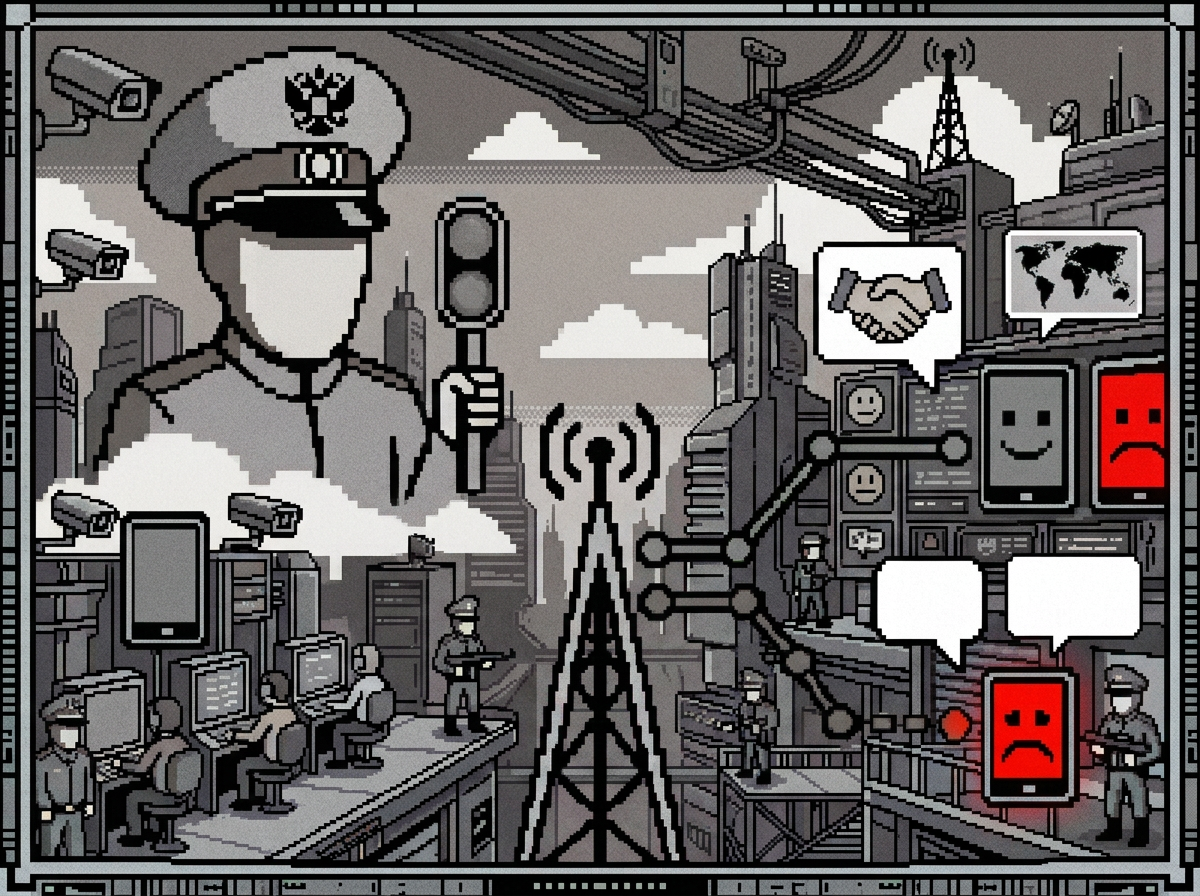
Russian powers set requirements for user equipment
On October 15, RBC (a major Russian business news outlet) reported on a draft order from the Ministry of Digital Development (Mintsifry) that sets requirements for 5G user equipment. Under the draft, devices must support the NEA7 and NIA7 algorithms no later than March 1, 2032.
NEA7 and NIA7
Strictly speaking, NEA7 and NIA7 are only names (slots reserved for algorithms). Right now, nothing at all stands behind them.
The 5G standard assigns numbers to radio interface encryption algorithms: NEA0 means no encryption, NEA1 is the European SNOW 3G, NEA2 is the international AES, and NEA3 is the Chinese ZUC. Slots four through seven are unassigned.
Russia proposes to fill slot seven with Kuznyechik (a Russian block cipher, also known as Grasshopper). NIA7 is the matching slot for the integrity protection algorithm. This is where the problem lies. The scheme has a slot, but chips have nothing to fill it with, because the international standard does not require it.
The ministry says that foreign smartphones will work as usual until 2032. Nobody knows what will happen after that, either to new devices or to the ones people already own.
This has nothing to do with reading your traffic
Headlines like “the state will be able to read your traffic” have nothing to do with reality as far as the Kuznyechik news is concerned.
These algorithms encrypt the radio link between the phone and the base station. This is a short segment, and the operator already decrypts traffic there today (the international AES protects it in exactly the same way). Messengers, banking apps and any tunnels run on top of this link. Changing the algorithm on this segment does not affect them.
The real problem lies elsewhere. If a phone does not support a mandatory algorithm, it cannot negotiate a connection with the network. The phone will simply have no connectivity, to blocked and permitted resources alike.
This is a far more serious level of control than anything we have written about before. You can bypass a website block. You can wait out throttling. Circumvention tools are useless against a refusal to connect, because they run on top of the connection.
How a network can keep a phone out
Through a registry
This approach needs a database. Authorities enter device identifiers into it. The operator checks devices against it and disconnects those that are missing from the list or flagged as banned. A government agency makes this decision. There is a legal basis for listing a device, a date, and at least a theoretical way to appeal.
Russia passed a law establishing such a registry in summer 2026, but the database is not operational yet. The government resolution describing how it works takes effect on March 1, 2027. Connecting information systems to it will take until 2028, and restrictions on unregistered devices are planned to start in 2028. We have covered a similar mechanism, as well as the link between the registry and the mobile internet shutdown regime.
Without any registry
If a phone cannot encrypt with the algorithm the network requires, the connection simply fails to negotiate. Nobody maintains a database, and nobody presses a button. There is nothing to appeal and no one to appeal to. The refusal happens on its own, during the technical handshake between the phone and the cell tower.
Closing in from all sides: what the state is doing to control communications
Certificates from the Mintsifry certificate authority
In August 2026, the websites of Russia’s largest banks switched to these certificates. Now anyone who needs to pay a bill installs the state root certificate themselves. We published a large study on these certificates.
SIM card requirements
Under official requirements, SIM cards must now be manufactured in Russia and run an operating system from the registry of domestic software. Their keys must be generated inside the country by an organization certified by the FSB (Federal Security Service).
The list of mandatory algorithms includes the same Kuznyechik. For 5G networks, foreign cards are banned completely. Vasily Dolgov, deputy CEO of the SIM card manufacturer Altair-2000, says that no SIM card on the Russian market meets these requirements, including cards issued by local operators.
A browser with Russian cryptography
CryptoPro (a Russian developer of cryptographic software) is building it. The FSB has approved the project, and there is no release date.
Requirements for user equipment
This is the draft order itself.
The reasons for the authorities to act now
Fourth-generation networks have operated in Russia for more than ten years, and nobody required domestic cryptography in them. Yet the draft order on 5G appeared in October 2026. The reason is that Russia launched commercial 5G networks on September 11, 2026: four operators, sixteen cities, about ten million subscribers. By mid-October, coverage had expanded to twenty-seven cities.
These networks mostly run on frequencies previously allocated to LTE. Operators received the new 4.63–4.99 GHz band at the end of August, but it only has pilot zones so far. The band requires Russian equipment, and no mass-produced domestic 5G base stations exist.
The device requirements arrive at a moment when the network is only starting to be built. The country still has few 5G smartphones, and the equipment for the new band has yet to be made (and it has to be Russian). Imposing such rules on a working 4G network used by tens of millions of people would be impossible. A network under construction is a different matter. The six-year deadline was chosen to match the pace of network construction rather than the readiness of chipmakers.
Can the algorithm itself be trusted?
A separate question is what kind of cipher the authorities want to build into every device. In short: no one has demonstrated the presence of a backdoor, but the developers have never explained a key element of the algorithm.
According to GOST R 34.12-2015 (the Russian national block cipher standard), the FSB’s Center for Information Security and Special Communications developed Kuznyechik with the participation of InfoTeCS. There was no open competition. By contrast, NIST (the US National Institute of Standards and Technology) selected AES from fifteen submissions and analyzed each one publicly.
In 2015, Alex Biryukov, Léo Perrin and Aleksei Udovenko showed that the substitution table (a key element of the cipher) was not generated randomly, although the developers claimed otherwise. The researchers recovered its structure through reverse engineering. Two more studies followed, with recommendations against using Kuznyechik.
The developers have not changed their position. They say they chose the table randomly, did not embed any hidden structure, and lost the program that generated it. Perrin himself stresses that there is no evidence anyone has exploited a possible backdoor.
What a substitution table is and why its origin matters
Almost every modern cipher runs data through the same transformations many times. One of them is the substitution table, or S-box: a table that maps each input byte to an output byte.
This table makes the relationship between the plaintext and the ciphertext as tangled as possible. By crafting the table in a special way, a designer can leave a subtle weakness in the cipher. Anyone who knows the secret behind the table can then exploit it.
That is why cryptography has a rule: the designer must explain where the numbers came from. They must either show the formula or prove the values are random. This is called the “nothing up my sleeve” principle, after a magician who rolls up their sleeves to show that nothing is hidden.
How the dispute unfolded
2015. At the CRYPTO conference, Biryukov, Perrin and Udovenko presented a paper showing that the table values were not random. A hidden algorithm had produced them, and the researchers managed to recover it. The full paper came out in 2016.
2019. Perrin described a construction that explains all previously found variants. He named it TKlog, after TC 26, the Russian technical committee that standardized the algorithms.
What the developers said. At a conference in Moscow in 2014, they explained that they repeated random generation until they got a suitable variant. Their documents for ISO were analyzed on Habr (a popular Russian tech community site). The documents state that the table was obtained through a careful search and that no secret structure was embedded. When asked directly, the developers added that they had lost the generation program.
The skeptics’ counterargument. You can find some kind of structure in any S-box if you look for it. The probability of finding this specific structure might be negligible. However, any alternative table would likely reveal some other structure with an equally low probability.
The response. Perrin showed that a short program can reproduce the table. A random table cannot be produced this way: the only way to describe it is to write out all 256 values one by one. If a program can generate the table, then an algorithm created it, and chance played no part.
Why this matters in 2026. The algorithm has not changed. The standard remains in force in the same edition, with the same table, and this is exactly the table the authorities propose to make mandatory.
Could it be a backdoor?
It has happened before, for example with an American standard.
2006. NIST includes the Dual_EC_DRBG random number generator in an official recommendation. The generator contains two constants with unexplained origins.
August 2007. Dan Shumow and Niels Ferguson of Microsoft show that anyone who knows the secret relationship between the constants can predict all future outputs of the generator. They stress that they are not accusing anyone.
September 2013. Documents leaked by Edward Snowden show that the National Security Agency (NSA) worked to become the sole editor of the standard. The NSA spent about $250 million a year on its program for inserting backdoors.
December 2013. Reuters reports that the NSA paid RSA Security $10 million to make the algorithm the default in a popular library.
April 2014. NIST withdraws the algorithm from its recommendations.
Six years passed between the first suspicion and confirmation.
Kuznyechik may or may not have a backdoor. But the doubts about its “random” numbers have a real basis: as the case above shows, this has happened before.
Who develops it and who profits
An FSB unit and InfoTeCS created Kuznyechik together. According to TAdviser (a Russian IT market analytics portal), InfoTeCS earned 8,598 million rubles (about $110 million) in revenue in 2022, 13,737 million rubles (about $170 million) in 2023, and 14,229 million rubles (about $180 million) in 2024.
The company’s flagship product, ViPNet, is a VPN built on Russian algorithms. Kommersant (a leading Russian business daily) estimates the market for such equipment at about 15 billion rubles (about $190 million). InfoTeCS holds more than half of it.
So a company that helped develop the algorithm now proposed as mandatory is also the largest supplier of products based on it.
Vasily Shishkin from the committee and Stanislav Smyshlyaev from CryptoPro led the TC 26 working group on cryptographic protocols. CryptoPro is the same company that is developing the browser with Russian cryptography.
We found no investigations, antitrust cases or public accusations against these companies. Major developers take part in creating national standards all over the world. Still, it is hard to miss how much the people who write the standards overlap with the companies that profit from implementing them.
We examined a similar setup in our article on the telecom reform. A requirement creates a market, and companies licensed by the same agency that issued the requirement serve that market.
Recommendations for developers of VPNs and circumvention tools
The key point: there is no way around this class of measures. Circumvention tools work on top of an established connection. If a device cannot get onto the network, there is nothing to circumvent.
The device registry follows the same principle. The difference lies in what triggers the cutoff. The registry relies on the identifier of a specific handset and an agency’s decision. Here, the hardware of an entire class of devices decides the outcome, and nobody makes any decision at all.
Watch for roaming exceptions. Almost every country that requires device registration for network access has one. In Azerbaijan, the requirement does not apply to tourists, and Turkey grants a 120-day grace period. Nobody knows whether Russia will have such an exception. For anyone serving users who travel to or from Russia, this is the primary open question.
What comes next. Expect plenty of interim decisions and clarifications (they usually appear before the legal deadline). The SIM card story is telling. The authorities introduced the requirement, the entire market fails to meet it, a transition period has been set, and nobody knows what happens next. The deadline for the new cipher requirements may well be pushed back. And then again. And again.
SIM card security
2G-era cards. Researchers broke the first version of the COMP128 authentication algorithm back in the 1990s, which made it possible to clone cards. Attackers could also break over-the-air encryption. The subscriber identifier went over the air in the clear, so IMSI catchers could easily tell who was nearby.
3G cards. The main improvement was mutual authentication. Previously, only the network verified the phone. Now the phone also checks that it is connecting to a genuine network. This closed off a whole class of fake base station attacks. These cards use the Milenage algorithm, which is built on AES. Third-, fourth- and fifth-generation networks still use it today.
4G cards. The same authentication scheme, with stronger over-the-air encryption. However, the permanent subscriber identifier can still go out in the clear during the first connection, so IMSI catchers keep working.
5G. The main privacy improvement: the phone encrypts the permanent identifier with the network’s public key, so it never goes over the air in the clear. This defeats older IMSI catchers.
By design, the fifth generation is significantly more secure thanks to identifier protection. However, Milenage has had twenty years of bug fixing, whereas its Russian counterparts have not had the benefit of such extensive testing.
There is no practical advice to give here: the operator issues the SIM card, and you have no choice.
International context
Requiring device registration for network access is not a Russian invention. According to the GSMA (the global association of mobile operators), more than a hundred countries maintain national databases of device identifiers. Regimes that block unregistered devices operate in Turkey, Azerbaijan, Chile, Colombia, Nepal and Egypt.
However, no country has ever required a national cipher in devices. China’s experience is telling here, because China faced the same task.
China has its own series of cryptographic standards, and a 2020 law requires their use in critical infrastructure. But China chose a different path. It proposed its ZUC cipher to 3GPP (the international standards body for mobile communications). ZUC became part of the standard and took the third slot in that same numbering scheme. Chipsets around the world now support Chinese cryptography, because manufacturers must implement the standard in full.
Kuznyechik is not part of the standard. That is why Qualcomm and Unisoc chips do not support it, and they obviously won’t.
China spent years on international standardization and won support worldwide. Russia demands support for an algorithm that is not in the standard.
What we don’t know
What will happen to devices people already own. Whether there will be a roaming exception. How the authorities will enforce compliance, given that a declaration of conformity does not verify compliance on its own. And whether the order will be adopted in its current form: the ministry says it is still revising the draft.
Conclusion
The state is actively trying to regulate the internet as tightly as possible. The authorities are deploying more filtering equipment, introducing new registries of approved services, and updating rules for ISPs and domain registrars. All of these measures decided where people could go online. But for now, Russians still have a choice: VPNs.
Now the state wants to decide for Russians whether they can connect to the network at all.