
A License in Exchange for Surveillance
Summary
- ISPs will get licenses only after they deploy SORM (SORM, the System for Operative Investigative Activities, is Russia’s lawful interception system for the security services). Currently, operators can install the equipment within two years of receiving a license.
- Four license tiers will replace almost 20 license types. According to documents circulating in the industry, a license may cost up to 50 million rubles (about $600,000).
- Sole proprietors (individual entrepreneurs) will be banned from providing telecom services entirely.
- Officials will be able to revoke operators’ licenses without a court ruling and bar them from obtaining new licenses for ten years.
- Surveillance equipment will cost more than a small operator earns in a year on average. One manufacturer’s published price list starts at 715,000 rubles (about $8,500) per system and 1.3 million rubles (about $15,505) for data storage. Experts estimate a complete setup at 40–50 million rubles (about $478,368–597,960).
- At the same time, federal operators are offering small providers a deal: hand over subscribers and lines. In return, small operators get 30–40% of revenue and no SORM costs.
- 27 Russian regions may end up with no regional ISP at all.
What Happened
Licensing reform has been under discussion since spring. Until October, the Ministry of Digital Development, Communications and Mass Media (Mintsifry) did not comment on it publicly. Concerned operators asked the government for details, and on October 7 the ministry finally responded. Gurgen Osipov, deputy director of the ministry’s Department of Telecom Market Regulation, signed the letter.
In the letter, Osipov complained that the current licensing system had a low entry threshold. As a result, the market included operators “with insufficient technical and financial capacity” that provided telecom services “without complying with the established requirements.”
So the issue, in their view, is a lack of entry barriers, and telecom services need more barriers.
The next day, Deputy Minister Dmitry Ugnivenko explained how the ministry plans to tackle this problem. He spoke at the “Telecom Regulation Outlook” session of the Digital Solutions 2026 forum.
Important: the text of the bill is not yet public. The ministry has drafted it but has not yet sent it for interagency review. It expects to submit the bill to the State Duma (Russia’s lower house of parliament) by the end of the year. For now, we only have media reports and officials’ accounts.
Background
February 2026. The ministry proposes allowing operators to cut off home internet for subscribers who refuse to switch from copper cable to fiber. The ministry estimates that this would affect about 5.8 million subscribers. Now the reason is clear: gigabit speeds over copper are impossible.
April 3, 2026. RBC (a major Russian business news outlet) reports plans to lift the moratorium on inspections of operators and to make SORM installation a precondition for starting operations.
April 14, 2026. The Association of Small Operators appeals to the president, the prime minister and the prosecutor general. It demands that they stop the reform and order an anti-corruption audit of the ministry.
April 28, 2026. Backbone operators ask to be exempted from the reform.
July 2026. A fine of up to ten million rubles (about $119,592) for repeat violations of SORM requirements takes effect.
Early October 2026. The ministry responds to the industry associations and outlines its plans publicly for the first time.
We have covered this trend before. We wrote about licensing reform as an infrastructure prerequisite for control here. We also wrote here about the gray zone of small ISPs, whose traffic did not always pass through TSPU as required (TSPU, “technical means of countering threats,” is the state-mandated DPI equipment that Roskomnadzor, Russia’s internet regulator, installs on operators’ networks).
What Is Changing
Licenses. Four tiers will replace almost 20 license types: municipal, basic, universal and general. According to documents circulating in the industry, a basic license will cost 1 million rubles (about $11,960), a universal one 10 million rubles (about $119,600), and a general one 50 million rubles (about $597,960). A general license requires connecting 10% of apartment buildings, while a universal one requires 15-30%.
Speed. Authorities have required operators to provide connection speeds of at least 1 Gbps per household within the next 10 years.
Revenue. At least half of an operator’s revenue must come strictly from telecom services.
Bans. Sole proprietors will be banned from providing telecom services. For repeat violations, authorities will be able to revoke licenses out of court and bar the operator from getting a new one for ten years.
Timeline. Operators get one year to reissue their licenses free of charge. For operators with licenses issued before September 2026, the new SORM requirements take effect on March 1, 2027. Existing licenses remain valid until the end of 2027.
A License in Exchange for Surveillance
We covered what SORM is and how it has evolved since the 1980s in a separate article.
Here is how it works now: license first, SORM second. After receiving a license, the operator has forty-five days to file an application with the FSB (Federal Security Service). It then has three months to draw up an implementation plan, and the plan gives the operator two years to put the equipment into service. Deployment takes eighteen months to two years. Throughout this period, the operator works legally without the equipment.
Under Article 13.31 of the Code of Administrative Offenses, fines for failing to install SORM ranged from 100,000 to 200,000 rubles (about $1,200–2,400). That is two orders of magnitude less than the cost of the equipment, so paying the fines was cheaper. In 2024, the maximum fine rose to one million rubles (about $11,960). Since July 2026, a repeat violation can bring a fine of up to ten million rubles (about $119,600).
Now operators will have to install the equipment before they get a license.
Separately, the government is lifting the moratorium on scheduled inspections of operators, which has been in place since 2023. According to RBC’s sources, this moratorium is what currently prevents authorities from checking whether operators have actually installed the equipment.
Real Costs
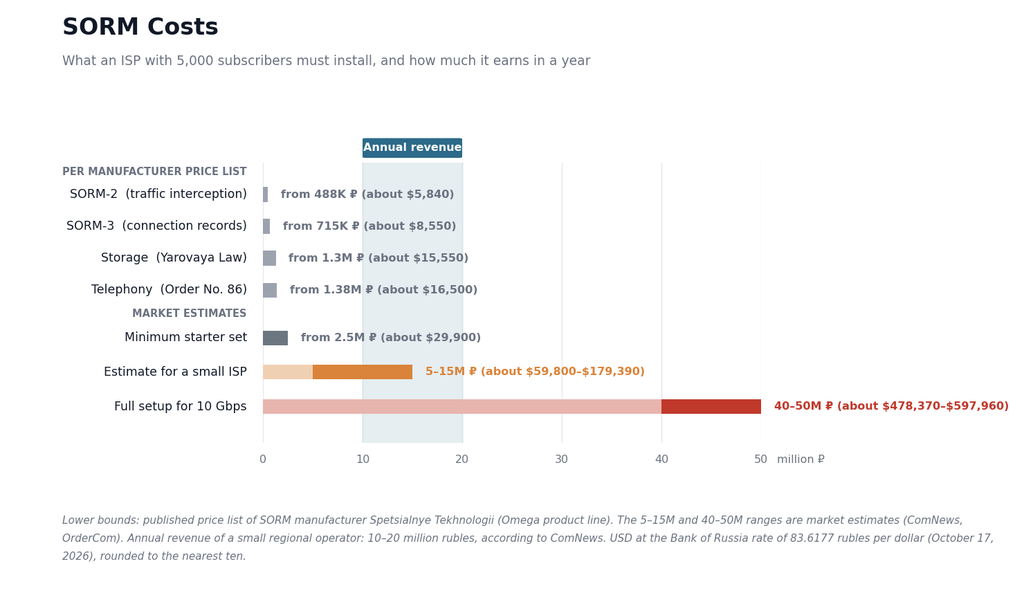
Almost no one publishes prices for this equipment. MFI Soft, Norsi-Trans, Signaltek and VAS Experts all state on their websites that they calculate prices individually. Only Spetsialnye Tekhnologii (“Special Technologies”) publishes a basic price list for its Omega product line. A SORM-3 system under Order No. 573 costs from 715,000 rubles (about $8,550). Storage for compliance with the Yarovaya Law (Russia’s 2016 law that requires operators to retain user traffic and communications) costs from 1.3 million rubles (about $15,550). The telephony component under Order No. 86 costs from 1.38 million rubles (about $16,500). And these are only the lower bounds.
What do these figures mean for market players? According to data from ComNews (a Russian telecom trade publication), SORM deployment costs a small regional ISP 5–15 million rubles (about $59,800–179,390). For high-bandwidth networks, the cost can exceed 30 million rubles (about $358,780). Dmitry Galushko, CEO of OrderCom, estimates a complete setup for an ISP with a 10 Gbps channel (roughly five thousand subscribers) at 40–50 million rubles (about $478,370–597,960).
Meanwhile, a small regional operator’s annual revenue amounts to the same 10–20 million rubles (about $119,600–239,190), or even less. Previously, operators could get a license first and then earn back the cost of SORM. Now they will have to find the money before they start operating. Many operators will likely choose to shut down, since they simply don’t have the money.
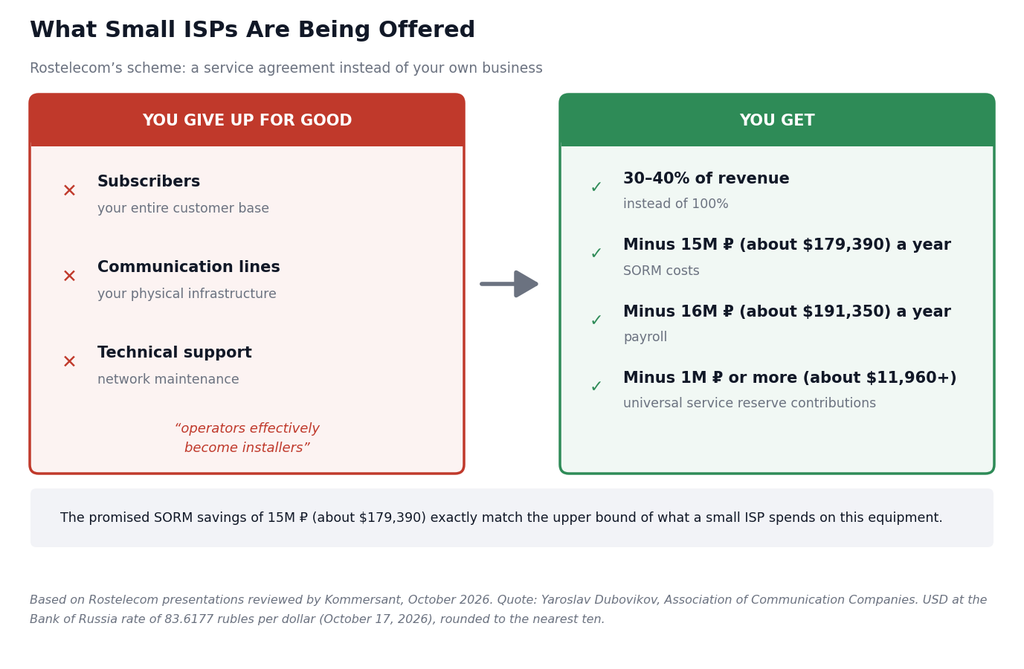
However, the government has a solution for small companies: share their users with large operators. On October 13, Kommersant (a leading Russian business daily) reported that Rostelecom (Russia’s state-controlled national operator) and TransTeleCom had started offering small ISPs service agreements of this kind.
Rostelecom’s scheme works like this: the regional operator hands over its subscribers, communication lines and technical support. In return, it receives 30–40% of revenue and no longer pays several major expenses: up to 15 million rubles (about $179,390) a year for SORM, up to 16 million rubles (about $191,350) for payroll, and from 1 million rubles (about $11,960) in contributions to the universal service reserve. In total, Rostelecom promises savings of up to 31 million rubles (about $370,740) a year.
TransTeleCom offers small providers the option to operate without their own license at all and without reporting to the regulator.
An interesting coincidence: the promised SORM savings of fifteen million rubles (about $179,390) exactly match the upper bound of the cost estimate for a small provider. In effect, the offer is tailored to those who cannot afford the reform.
Yaroslav Dubovikov, executive director of the Association of Communication Companies, says that under these terms operators effectively become installers. Previously, Rostelecom at least bought companies. Now it takes 60% of the business without investing anything.
“SORM outsourcing” as a service is nothing new. It existed before and still exists under the name “outsorming” (a blend of “outsourcing” and “SORM”). For a channel of up to 1 Gbps, connection costs 330,000 rubles (about $3,950) upfront plus 49,000 rubles (about $590) a month. For a 3–5 Gbps channel, it costs 580,000 rubles (about $6,940) plus 69,000 rubles (about $825) a month. The first line of the price table is even labeled “for license renewal”: 350,000 rubles (about $4,190) plus 42,000 rubles (about $500) a month. So the market has long been selling operators the right to operate, and the price list doesn’t even hide it.
Under this model, the owner of the equipment has no access to the transmitted data. However, if licenses are issued only after SORM deployment, it is unclear whether outsorming will remain an option. Today it lets operators meet the requirement without buying equipment, while the new approach ties the license to the actual installation.
The reform puts pressure on more than just small telecoms. In April, three backbone operators (GlobalNet, Rascom and RetnNet) asked the ministry to exempt them from the reform. The bill’s requirements target operators that serve end subscribers and ignore infrastructure providers altogether. A requirement to connect 10% or 30% of apartment buildings makes no sense for a company that carries transit traffic between operators and doesn’t serve residential customers. Alexey Zakrevsky, CEO of GlobalNet, proposes evaluating such operators by channel capacity, node fault tolerance and participation in internet exchange points (IXPs). He also suggests adapting SORM requirements for operators that do not deal with end users.
What the Industry Says
Collective punishment. The ministry says the reform does not involve transferring ownership of networks. According to the ministry, an interagency commission will only appoint a managing operator for a limited period. Alexey Amelkin, president of Makatel, responds:
The Ministry of Digital Development has effectively admitted to plans to monopolize the market, however it tries to justify them. The argument about non-compliance with legal requirements cannot justify carving up the market. In essence, this is collective punishment of small and medium-sized businesses
Amelkin also says that large companies often operate on the edge of stability, sometimes in the “red zone.” In other words, there are no reliable large players.
No criteria. Alexey Sturov, president of the Association of Communication Companies, points out that the ministry has not announced any criteria for evaluating operators and that no statistically valid data exists. He also recalls how the mobile operator market collapsed in the 2000s.
Redundancy. The Association of Small Regional Operators notes that penalties for violators already exist. Fines for SORM violations rose to 1 million rubles (about $11,960) in 2024, and to 10 million rubles (about $119,600) for repeat violations in July 2026. So the ministry proposes punishing operators twice for the same violations.
Higher prices. Oleg Grishchenko, president of Rostelesset, says that weaker competition will hurt service quality and drive prices up.
What This Means for Circumvention Tool Developers
[Illustration: control points today and after the reform]
This section is for developers of circumvention tools and researchers of network restrictions. Their services depend on how the filtering landscape changes. We will publish more recommendations once more details about the bill emerge and once authorities start enforcing it.
Configuration Diversity Is Disappearing
Today Russia has hundreds of operators. Each one has its own deep packet inspection (DPI) equipment, its own firmware version, its own level of care in configuration and its own interpretation of the requirements. That is why a bypass method that stops working on one ISP keeps working on another. After consolidation, there will be an order of magnitude fewer configurations, and they will be more uniform.
Blocking Updates Will Become More Synchronized
Right now, a new blocking signature rolls out across the network unevenly, and users get a window when something still works. With only a few federal operators, a change will reach everyone at once.
The “Gray Zone” Is Closing
Small ISPs whose traffic did not always pass through TSPU as required were a natural source of diversity. The requirement to install SORM before launch, combined with the return of scheduled inspections, eliminates this group of providers as a class.
Measuring Blocking Will Get Harder
Record the diversity of test vantage points now, while it still exists. In two years, 2026 measurements from small regional networks will become historical records. There will be nothing to compare them with, because the networks themselves will be gone. If you run measurements, keep per-autonomous-system (AS) breakdowns, not just country-level aggregates. These breakdowns show how differently filtering works across operators.
Connectivity Trouble
One more point for those who think about infrastructure. The backbone operators asking for an exemption from the reform are the very transit nodes and traffic exchange points. If the requirements written for residential networks apply to them, the damage will go beyond the market: the connectivity of the Russian internet segment will suffer too.
Perspectives
The ministry has drafted the bill but will not send it for interagency review until it meets with the operator associations. The meeting took place on October 16, 2026. The ministry expects to submit the bill to the State Duma by the end of the year.
Conclusion
Established from public statements: the ministry acknowledges that its goal is to raise barriers to market entry. Authorities plan to issue licenses only after SORM deployment, revoke them without a court ruling, and ban sole proprietors from the business. The timeline is known, but the text of the bill is not public.
Established from open data: surveillance equipment costs significantly more than a small operator’s annual revenue, which makes it an insurmountable obstacle to operating.
Not established: how the rules will work in practice. Officials justify the reform by the need for better connection quality and operator accountability. In practice, the reform ties the right to operate as an ISP to installing equipment for monitoring subscribers. None of the industry representatives we surveyed object to better connection quality. They object to the cost at which it comes and to whom it benefits.
Update, October 19: Mintsifry Schedules a New Meeting with Operators
The meeting we mentioned above took place on October 16, as it was scheduled. Participants included representatives of the associations of communication companies, small regional operators and telecom operators, as well as Makatel, Obltelesset and Rostelesset. The Ministry of Digital Development, Communications and Mass Media (Mintsifry) scheduled the next meeting for October 23. The ministry asked the associations to prepare 5-8 proposals for changes to the reform.
Market representatives welcomed the ministry’s willingness to hear them out. Mintsifry said it would keep discussing contentious issues with the associations in a working group. The participants also discussed a municipal version of the universal license. An operator would have to pay 10 million rubles (about $119,590) for it, and its minimum authorized capital would have to be 25 million rubles (about $298,980).
Earlier versions of the reform required 100 million rubles (about $1,195,920) of authorized capital for a universal license. The associations estimated the cost of entering the market at 111 million rubles (about $1,327,470). The ministry disputed this calculation. It pointed out that the associations had added together equity, the state fee and the contribution to the universal service reserve.
The parties have not yet agreed on the transition period. Mintsifry proposed one year, although some participants understood it as “over a year.” Some associations insist on at least three years. The ministry still expects to submit the bill to the State Duma (Russia’s lower house of parliament) by the end of 2026.
The day before the meeting, the associations proposed an alternative to revoking licenses without a court ruling. Instead, authorities would suspend the operator’s activities, and the operator would keep ownership of its networks.
According to the Alliance of Alternative Telecom Operators, Russia has about 4,700 operators, not counting federal players. At a press conference in September, the associations said the reform could push thousands of small providers out of the market. In their estimate, more than 50 million people risk losing access to quality connectivity.
For now, everything points to Mintsifry making a couple of concessions and showing that the process is transparent, while keeping the law as it is.
Sources for This Update
- ComNews, “Mintsifry Heard Thousands of Small Operators”, October 19, 2026. The list of participants, the meeting’s outcomes, the new date, the figures discussed and the positions on the transition period.
- Frank Media, on the estimates of the Alliance of Alternative Telecom Operators and the associations’ proposal to replace license revocation with suspension.
- Kabelshchik (a Russian telecom industry outlet), on the calculations of market entry costs and the ministry’s objections.